Asia-Pacific Is Three Single-Portion Markets, and Only One of Them Is a Growth Story
China compounds at 15-20% a year from a hardware base under 3% household penetration, Korea returns results fastest, and Japan is the longest game in the region
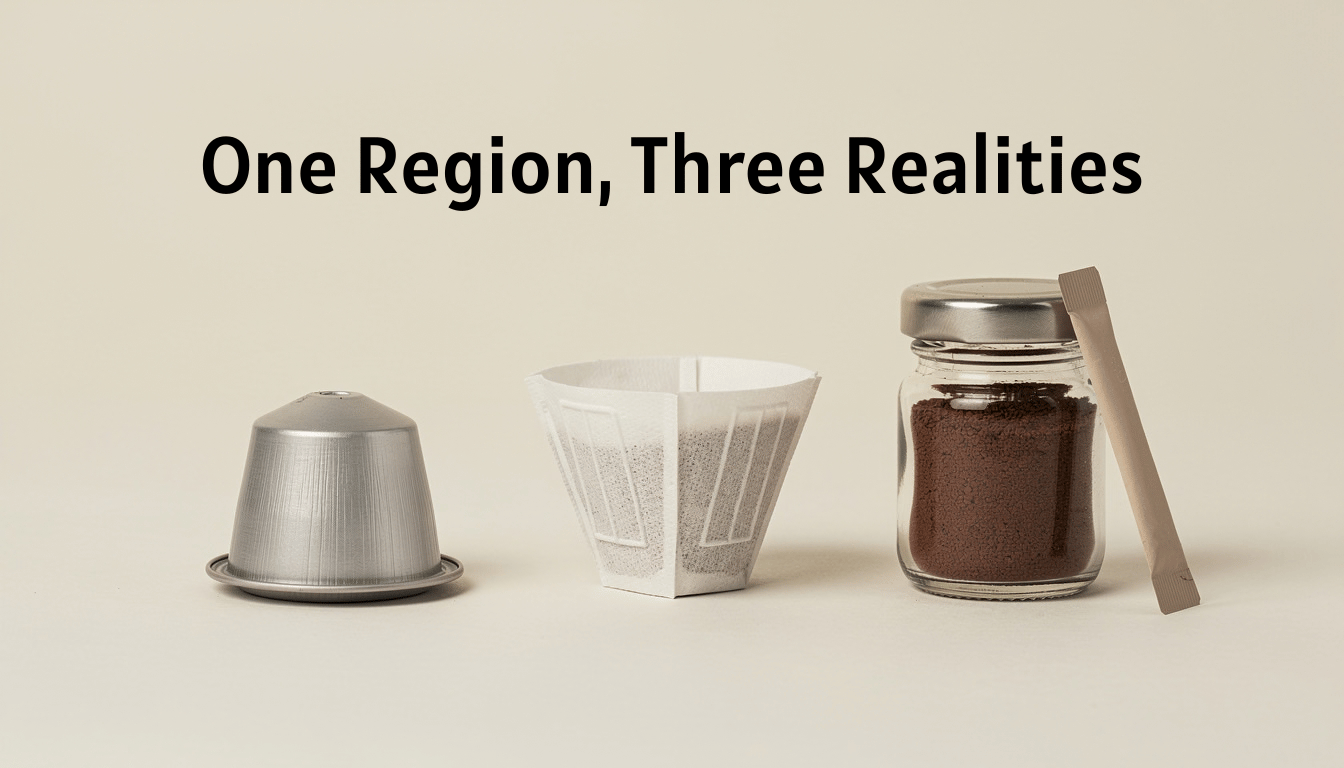
China compounds at 15–20% a year from a hardware base under 3% household penetration, Korea returns results fastest, and Japan is the longest game in the region
The Question Came From the Room
In AMI’s recent Single-Serve Capsules Conference in Málaga, the useful question arrived after the slides. A capsule maker asked which of the three markets, China, Japan or South Korea, a company should choose first if it wanted to run a filling operation in Asia rather than ship capsules in from Europe.
The answer is not the biggest market. It is Korea, if you want to see results. It is Japan, if you are prepared to wait and play for size. It is China, if you are willing to run a marathon and trust that the market will still be there in nine years, which it will.
That sequencing answer only makes sense once you accept that these are three markets with three different structures, three different consumer relationships with coffee, and three different sets of channel rules. One template does not travel between them. This volume is what the room heard about each.
The Numbers That Matter
Metric Value
China total coffee market (2025) ¥354.9B (~US$51.9B), +13.3% YoY
China single-portion market (2025) ~RMB 10–15B (US$1.5–2.2B), 15–20% CAGR
China capsule/pod volume (2025) ~400–600M units · 8–12% of formats · 15–20% CAGR
China capsule/pod penetration Under 5–10% (Western Europe: 25–40%+)
China per-capita consumption 28.57 cups/yr (2025); 16.74 (2023) → 22.24 (2024) → 28.57 (2025)
China, first-tier cities (indicative) ~106 cups per person per year in Shanghai
China machines 207K–310K capsule machines sold 2025; 3.8M+ closed-system installed base; 8.42M cumulative ownership, household penetration <3%
China branded coffee shops 87,505 (2025); first market to add 20,000+ net new in a year; chain rate 53%
Japan capsule/pod segment ~US$100–133M (~JPY 15–20B), 2–3% CAGR
Japan core coffee market ~US$3.47B (~JPY 520B), ~2.1% CAGR to 2035; ~340 cups per capita
South Korea capsule/pod segment
US$218–327M (₩300–450B), 8.8% CAGR; core market ~US$5.37B
South Korea per-capita consumption 416 cups/yr (2024), highest in Asia
China format shift by 2030 traditional instant 70% → 55%; capsule/pod 5% → 15%
28.57 cups against 106.
① China Is the Growth Story, and the Buyer Is New
The national average says Chinese consumers drink 28.57 cups of coffee a year. Shanghai says something else entirely: roughly 106 cups per person per year. Both numbers are true, and the distance between them is the whole investment case.
That national figure averages coffee drinkers with the far larger group that has never started. In the first-tier cities (Shanghai, Beijing, Shenzhen, Guangzhou), coffee is already a daily habit and the market behaves like a saturated one. What makes the rest of the country interesting is who lives there and where they come from. Workers who moved from lower-tier cities of one to ten million people carry first-tier habits home with them, and the habit follows the person rather than the postcode.
Format mix tells the same story. Instant coffee still holds 70–75% of China’s single-portion volume at a decelerating 5–8% a year, while capsule and pod is the smallest format by volume at 8–12% and the fastest-growing at 15–20% (2025). By 2030 the projected mix moves to 55% instant and 15% capsule/pod. Read that as a shift toward value per serving: the country is trading a cheap habitual format for more expensive ones.
Two details from the ground are worth more than the totals.
First, pricing power. Capsule and pod units sell in a wide band: instant at 1–2 RMB (US$0.15–0.29) per serve, premium capsules at 4–8 RMB (US$0.59–1.18), with the mass market at 3–6 RMB (US$0.44–0.88) and a premium halo above it. A player that enters only at the top is fighting for the smallest part of a young category.
Second, what “freeze-dried” coffee means in China. Local producers borrowed extraction techniques from the Chinese pharmaceutical and traditional-medicine industry, where preserving aromatic compounds and active ingredients from plant material is an old discipline. Applied to coffee, it produces a micro-ground freeze-dried product that tastes nothing like the Western equivalent and grows at 8–12% a year.
There is one honesty check on all of it. Most of the numbers above come from e-commerce platforms (Tmall, JD, Douyin, Pinduoduo), because that is where Chinese consumer data is visible. Offline and B2B sales are not in those figures, which means the real market is probably larger than reported. And after an exceptionally strong 2025, the first half of 2026 was soft for single-serve purchases: households had bought in, and they were still drinking what they had.
② Korea Returns Results Fastest, Japan Returns Most Slowly
South Korea drinks 416 cups per person a year, the highest per-capita consumption in Asia, on a core coffee market of roughly US$5.37B. Its capsule and pod segment runs at US$218–327M and grows 8.8%, the fastest of the three mature markets, on an overall market expanding near 9.7%.
Structure here is domestic. Maxim, from Dong Suh Foods, sets the bar in capsules as a local champion rather than an imported one. Consumers are educated and premium-seeking, willing to invest in machines, and treat equipment as something to be seen as well as used. That social and aesthetic dimension is not decoration; it is a product requirement.
What remains open is premium and speciality, stacked against a domestic mass-market incumbent. Competing on volume against Maxim is competing on Maxim’s terms. Competing on provenance, roast differentiation and design is not.
Japan is the opposite proposition. It drinks about 340 cups per person, has a core coffee market of ~US$3.47B growing around 2.1% to 2035, and runs a capsule and pod segment of US$100–133M at 2–3% a year. The category dipped slightly in 2025 on inflation. Size is there; velocity is not.
Single-portion in Japan is dominated by drip pods rather than capsules, because the pour-over ritual carries the quality expectation. Consumers will not trade ritual for convenience, so innovation has to fit the existing brewing habit instead of asking anyone to change it. Add an installed base locked into existing systems, a domestic regulatory apparatus, and negotiation timelines measured in quarters rather than weeks, and Japan becomes the market you commit to rather than the one you test.
China sits between them on speed and ahead of both on growth. Chinese business owners are pragmatic: the relationship takes time to build, and decisions accelerate quickly once trust exists. Marathon pacing with sprint economics at the point of decision.
③ The Capsules Mostly Arrive From Somewhere Else
Ask where Asia’s capsules are physically made and the region splits by material.
Aluminium capsules are largely imported from the Western supply base. Plastic and bio-based capsules, including compostable ones, are made in China at scale, for domestic demand and for export to neighbouring Asian markets. Fillers and brands that depend on aluminium are therefore exposed to shipping, duty and lead times on their consumable, while their competitors in plastic and compostable formats sit next to the production.
Where the category has not moved is waste. Compostable capsules exist on the market (UCC’s EKOPOD in Japan), while collection infrastructure for aluminium and plastic stays thin across the region. A portion that arrives with no capsule at all does not exist in any of the three markets.
That gap is the competitive question of the next five years, and it is being framed differently in each country. Sustainability in China is pushed from the city level rather than the centre: municipal governments in the large cities are the ones applying the pressure, which makes it a commercial factor rather than a distant regulation. In Japan and Korea the sustainability message already lands strongly with consumers, including paper drip and non-capsule formats.
One caution travels with the opportunity. The message only works if it is real. Sustainability positioned as marketing, without a verifiable format behind it, is the fastest way to lose a market that checks.
The Question for the Region
Three markets, three entry templates, and one position nobody occupies yet. Which one would you fill for first?
Thinking about entering a new Asian coffee market?
Ad Astra Coffee Consulting helps coffee and F&B brands navigate China and Asia-Pacific — market intelligence, entry strategy, and execution. Book a strategy call or read more in Asian Coffee Insider.